It is a sound that Jim Whitfield will likely never forget.
Tropical storm and hurricane force winds pounded the metal siding of the Harrison County Courthouse for hours on August 29, 2005.
That sustained collision of wind and the metal created a humming sound.
“When the wind gets to a certain speed, it will catch a resonance, and it will hum,” Whitfield told The Enterprise-Tocsin during a recent interview about his experience on the Mississippi Gulf Coast during Hurricane Katrina’s landfall twenty years ago. “I can hear that humming almost now.”
Whitfield has spent most of his life in emergency management.
From 1996-2004, he served as Sunflower County’s emergency management director before taking a state job in February 2004 as an emergency response coordinator for the state health department. He has since retired from the agency after nearly 18 years there.
At the time, he was a coordinator for a nine-county district, one of nine such districts in the state.
“It was not unusual for us to be deployed to the coast for storms,” he said.
Prior to joining the health department, Whitfield said that he had experience in Hancock County, which borders the eastern Louisiana border.
“I knew the area, and I knew the people, so whenever we started deploying for storms, I would ask for Hancock County,” Whitfield said.
All three of Mississippi’s coastal counties, Hancock, Jackson and Harrison, were heavily impacted by the devastating hurricane, which at one point had intensified to a Category 5 before weakening to a Category 3 at landfall.
“A Palpable Shift in the Forecast”
Hancock County, where Whitfield arrived on August 27, two days before landfall, would go on to suffer the worst devastation along the coast.
“Going down on the 27th, it was pretty straightforward,” Whitfield said. “We’re going to go for three, four or five days and be done. That was kind of the typical window.”
When Whitfield arrived, he made contact with local emergency management officials at the Hancock Emergency Operations Center.
Whitfield’s priority there was to make sure that there were contingency plans for health care facilities, including the then Hancock Medical Center.
“Sometime Saturday night into Sunday morning, I don’t remember the exact time frame, but the tone of weather service bulletins and forecasts shifted,” Whitfield said.
The Slidell, Louisiana, office of the National Weather Service issued a bulletin on Sunday indicating that the rain and storm surge from Katrina would be as bad or perhaps worse than Hurricane Camille, which had slammed the Mississippi coast in 1969, and up to 2005, was the worst recorded hurricane in the state’s history.
“There's a school of thought that a lot of the deaths that occurred from Katrina, in Mississippi, should be credited back to Camille’s account, because people would specifically tell us, ‘where I am, water never got there during Camille, and we’ll be fine,’” Whitfield said. “And they weren’t.”
As Sunday rolled on, the forecasts became more intense.
“There was a very palpable shift in the forecast,” Whitfield said. “At that point, it shifted from routine to ‘this is going to be very bad.’ It was to the point that we knew that this would require much more attention than we had given any prior storm. It was language that captured our attention more than standard language did.”
“It was bad for them, as the storm made landfall”
The talk at the EOC shifted from management to evacuations.
“As the forecast became more intense and more real, that chatter started to reflect it,” Whitfield said.
At some point that Sunday, Whitfield received a phone call from one of his supervisors in Jackson notifying him that the National Guard and the Mississippi Emergency Management Agency representatives on site were planning to leave.
He told Whitfield to prepare his group to go north, possibly to Camp Shelby.
“Naturally, there was a little bit of a disagreement, because we were sent there to help,” Whitfield said.
Whitfield knew that he could not stay in Hancock County--more specifically Bay Saint Louis--where he had been stationed that day.
Anticipating that they may not be able to get back in the days after landfall, Whitfield’s group decided to go east to Harrison County.
“That way, we would at least only be 30 minutes down the road and could make our way back, versus an hour away and trying to plow through trees to get there,” he said.
Whitfield said that he and others attempted to talk the local Hancock County EMA and staff into leaving the EOC.
“Their response was similar to ours. “These are our people, we can’t leave,’” Whitfield said. “Ultimately, they stayed right where they were. It was bad for them, as the storm made landfall.”
As it turns out, roadways ended up being nearly impassible in many areas up to 60 miles north of the coastline.
“The assets that had been staged at Hattiesburg quite literally had to chainsaw their way to the coast. They had to saw their way all the way down Highway 49,” Whitfield said.
“It’s a long time to listen to the wind blow at 75 to 100 miles per hour or better”
Meanwhile, in Harrison County, Whitfield and others sheltered there as the storm made landfall.
There were the lighter gusts before the tropical storm winds hit. Then the tropical storm winds arrived, and later, hurricane-force winds hit, and Katrina’s full wrath pounded the Gulf Coast for close to 12 hours, Whitfield said.
That was followed for several more hours by a reversal of those wind patterns.
“It’s a long time to listen to the wind blow at 75 to 100 miles per hour or better. It’s a very long time,” Whitfield said, noting that constant hum from the wind and the metal.
Every now and then, a lull in the storm would allow for a brief look outside, but no one was leaving the building.
Communication between Harrison and Hancock County officials began to deteriorate.
“We were getting bits and pieces of communication from Hancock County, and it was not good,” Whitfield said. “It was very bad. And the longer we went, the less frequent those bits of communication came. At some point they stopped, and we didn’t know what happened to those folks.”
Overflow calls to 911 dispatchers were patched into the Harrison EOC.
“We had people that would call, and their house would be breaking up around them. We had people who were taking a call, and they would stay on the phone until the line went dead,” Whitfield said. “We didn’t know what happened to them… It was a very heavy air about it, because we knew what was taking place in the community. We understood what was transpiring.”
“By now, you've seen the videos...but you haven't seen the faces”
Once Katrina’s wrath had pushed northward, the real job for Whitfield and his emergency management colleagues had only started.
It ended up being a months-long affair for Whitfield, who split his time between the Delta, Jackson and the coast until March of 2006.
As Katrina was barreling toward the coast that Sunday in the then Gulf of Mexico waters, Whitfield started an email update that at the time only went out to a few family members and close friends.
“It seems that a young lady named Katrina has chosen to visit the Mississippi Gulf Coast sometime late this weekend or early Monday,” Whitfield said in an email sent at 5:49 p.m. on August 27. “The Mississippi Department of Health's welcoming committee, of which your son/brother/grandson is an esteemed member, has been requested to greet Madame Katrina at her arrival.”
Whitfield had been deployed to the coast for storm response multiple times before Katrina. This was the first time that he had decided to keep a journal in the form of an email newsletter.
“I normally did not (write email updates),” Whitfield said. “Usually, things would get resolved in a week or so that didn’t require our personal presence.”
Whitfield updated his family just before the storm hit, and then communication went silent for the next few days.
“When it picked back up, more people started to be added to the distribution,” he said. “It was more like a running diary. Especially post storm, people were curious about the ground truth and the first-hand account.”
And what was happening on the ground was unfathomable.
“Happy 5AM!!! My first email since Sunday evening....all possible due to modern satellite technology. In case you're wondering, this email took a 50,000-mile round-trip up to the satellite and back to reach you,” Whitfield began his email on the Thursday following the storm’s landfall. “To say it's bad, horrible, terrible, sad, unimaginable, etc. would be understating the situation on the coast. By now, you've seen the videos...but you haven't seen the faces.”
The emails, Whitfield said, are not read often, but they tell a story he said might be impossible for him to tell if he did not have them. Whitfield can recount lots of experiences on the coast, he said, but the storyline is something that has been pushed back into the corners of his mind.
“Pickup trucks were pulling in with their cargo beds loaded down with muddied and
broken patients”
When officials arrived from Florida to help with the recovery, Whitfield became instant friends with Rick Rhodes, who was then his counterpart in the Sunshine State’s health department.
Rhodes recounted his experience to Florida officials by way of memoranda weeks after the storm.
“There was no infrastructure left south of I-10,” Rhodes said in his statement, which was provided to The E-T for this project. “No communications, no electric, no water, not even a port-o-let. There was no security at the EOC; people coming and going as they pleased; it was a scene of total chaos.”
He then visited the county hospital, which had initially evacuated its patients to the ground floor, anticipating a surge event.
It soon became a flood event, and all patients were taken back to the higher floors, Whitfield said.
At one point, the lobby was described by staff as being like a giant aquarium, Whitfield said. The large glass windowpanes were surrounded by several feet of water, and fish and other aquatic life were swimming around the facility.
When Rhodes arrived, the water had receded, but problems were mounting.
“The hospital was as chaotic as the EOC if not more so,” Rhodes recalled. “The emergency care was being provided outside by the hospital staff. Pickup trucks were pulling in with their cargo beds loaded down with muddied and broken patients. These people were being pulled from trees and buildings two days after the storm. The hospital’s first floor was saturated with 6-7 feet of saltwater. There were buckets of blood being placed outside the entrance, hypodermic needles in the parking lot, beds and equipment scattered about the outside.”
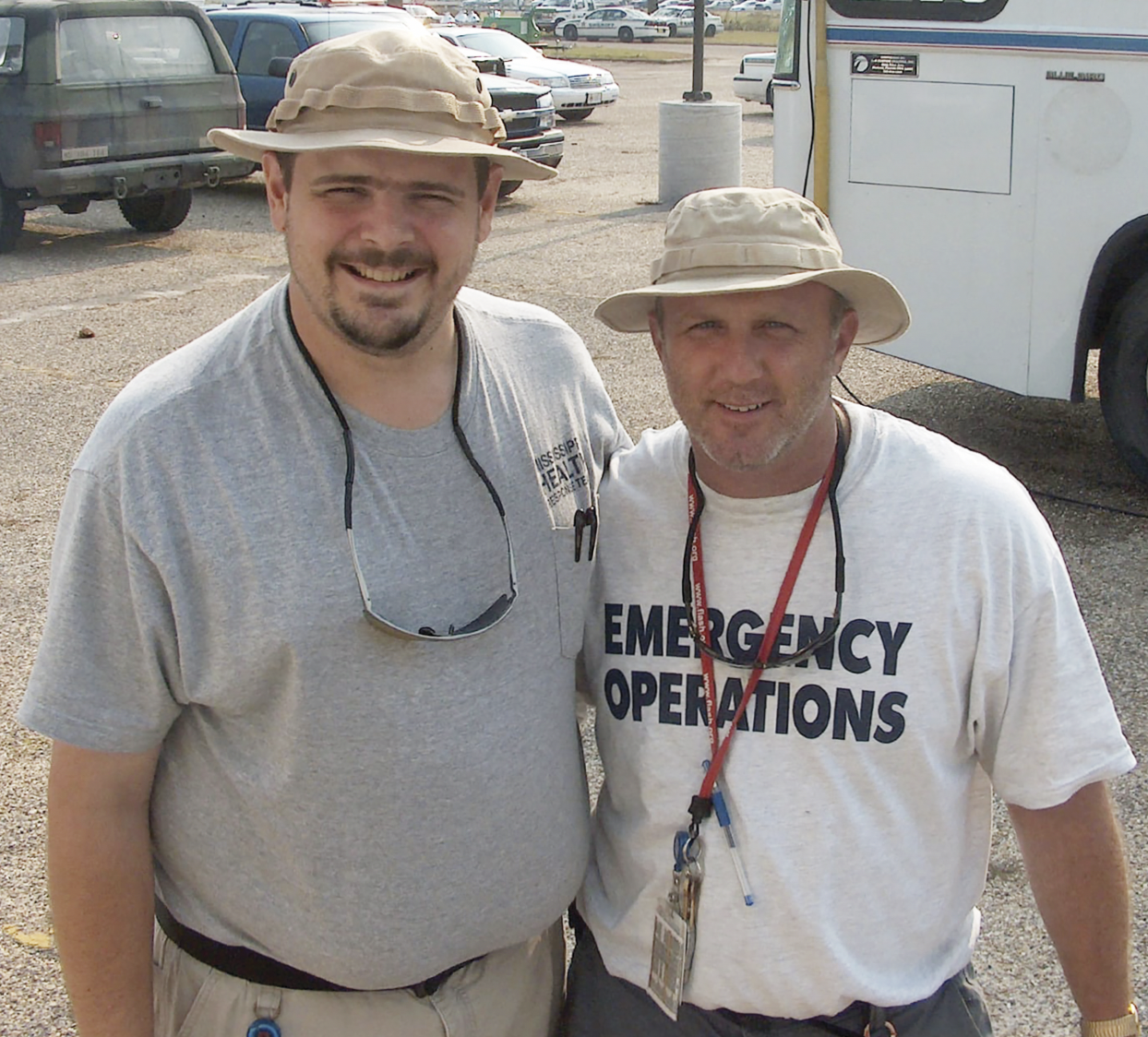 Photo for The E-T
Jim Whitfield provides this photo of himself, pictured left, with his Florida health department counterpart, Rick Rhodes, in the aftermath of Hurricane Katrina.
Days after the storm turned into weeks and then months.
By December, Whitfield said, the coast was far from being back to normal business. The road to recovery would be long, but citizens and officials alike looked for anything that could be perceived as light at the end of the tunnel.
“A few weeks after the storm, the sheriff’s department reported its first DUI arrest,” Whitfield quipped. “Somebody somewhere got hold of enough alcohol to get drunk with. That shot a much-needed dose of levity into it.”
“My next trip down will likely be met by warm, humid, southerly breezes and gales”
As winter turned to spring in 2006, another hurricane season was looming, but Whitfield’s time on the coast due to Katrina was coming to an end.
“If yesterday was slow, today was slower,” he wrote to friends and family on March 23, 2006. “The routines of recovery now revolve around debris removal and FEMA trailer-related issues. About 1/2 of the debris has been cleaned up, which has dramatically improved the view afforded to passers-by… As I said earlier in the week, this will likely be my last rotation to the coast for this purpose. However, recovery will take much, much longer. The 2006 hurricane season is only about 9 weeks away, and with the first storm that enters the Gulf of Mexico, the Mississippi Department of Health's emergency response coordinators will be back in our assignments in the three coastal county emergency operations centers. As I write this email the winds are cold from the north. My next trip down will likely be met by warm, humid, southerly breezes and gales.”
Years after Katrina, Whitfield said that he was teaching a firefighter course inside of a metal building in Carroll County.
A thunderstorm boiled up, and the wind began to blow so hard that when it hit the metal building, it created an unmistakable humming sound. Memories, long ago buried from the 2005 hurricane, came back in an instant.
“I had to stop the class,” Whitfield said. “I just needed to stop for a minute, because it brought back all of that stuff.”
Twenty years later, Katrina’s winds are still blowing in the minds of those who experienced her devastation. They can be suppressed, but they will never be forgotten.