Their love story is one framed within a love for humanity, cut short by tragedy, and perpetuated with telling the story of equality.
Indianola native and author/historian Zellie Rainey Orr probably never thought that she would cross paths with civil rights icon Charles Scattergood.
The former graduated from Gentry High School in 1969 and moved to Los Angeles. The latter travelled the world with his father, a scientist for the U.S. Bureau of Fisheries. The two were set to marry in May of 1999, but Scattergood died in a car accident on February 9, 1999. “When I met Charlie, he said, ‘I’m going to give you everything you need,”’ Orr recalled. “I didn’t quite understand it at the time.”
By the time the two had met both had lived very full lives. Orr had been married and divorced and Scattergood had lived a life in pursuit of equality for all humanity. As a member of the Student Nonviolent Coordinating Committee at Washington State University, he fought unfair housing practices against minorities in Kennewick, Washington.
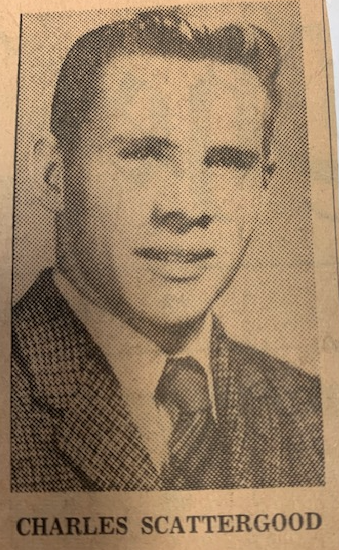
He later went to San Francisco to protest for the rights of workers, had his jaw broken, and was jailed alongside another civil rights icon, Dick Gregory. For his work on the front for justice and equality, Scattergood had been selected to participate in nonviolent tactics training at Western College for Women along with civil rights workers James Chaney, Andrew Goodman and Michael Schwerner.
On June 21, 1964, the day Scattergood arrived in northern Mississippi, the three civil rights workers came up missing. “When he came to Indianola, he stayed at Mrs. Irene McGruder’s house, which was a Freedom House that (was later) destroyed by a firebomb,” Orr said. “The Indianola newspaper carried the story about the incident and there was a picture of three little girls playing in the yard. I was one of those girls.”
While in Indianola, Scattergood helped register many local people to vote. “We had a civil rights reunion in 1999 and I suggested that we name a street after him,” Orr said. “But Otis Brown suggested that we name an apartment complex (Charles Scattergood Villas) after Charlie because he fought for equal housing. And Otis said, ‘“Scattergood took me to vote.”’
Several of Scattergood’s experiences and contributions were left behind to Orr, who had begun to become well-established in her own right.
Orr had several letters that Scattergood had written to friends and family and a letter from the Rev. Dr. Martin Luther King dated December 31, 1964.
In the letter, King was requesting that in light of the acquittal of those accused of Chaney, Goodman and Schwerner’s murders that the U.S. Congress consider seating alternative representatives from the Mississippi Democratic Freedom Party.
“Charlie had always told me that he had a letter from Martin Luther King,” Orr said. “Much of his writings, letters and papers had been in storage for several years. When I found the letter, I wrote to the King family but never heard back. The envelope has the King’s real address on it and it’s typed in black ink and signed in blue ink. I authenticated the latter with a newspaper article where Dr. King was in Atlanta three days later using some of the very same verbiage that was in the letter to Charlie.”
Orr, a historian, has preserved the letter in a glass case and has taken it to schools, speaking engagements and public event over the years.
Her betrothed was ten years older than she and the two never got a chance to do the happily ever after. However, Scattergood’s time spent with Orr awakened a creative spirit for preserving narratives and paying tribute to African American culture.
Orr is the official historian for the Tuskegee Airmen and the author of several books including “Change and Progress,” “Georgia: A History of Change and Progress,” and “The First Top Guns.” As the official historian of the Tuskegee Airmen, she has many film credits and awards to her name as a consultant and contributor – most notably on the 2012 blockbuster film, “Red Tails.” “My story will be told in due time,” she said. “But I think it’s very important to see how Charlie’s travel to places like Norway and Panama and throughout our nation shaped his worldview of humanity. He had experiences very early in his life that led him to appreciate everyone else throughout his life.”