The big mystery of how each school board member voted on the closures of Inverness Elementary and East Sunflower Elementary was resolved during Tuesday night’s meeting of the Sunflower County Consolidated School District Board of Trustees meeting.
District 1 Trustee Emma Golden abstained, Board President and District 2 Trustee Edward Thomas voted nay, District 3 Trustee Debra Johnson voted yes, District 4 Trustee Evelyn Woods voted yes, and District 5 Trustee Melanie Townsend voted yes.
This was answered during some tense exchanges with the public that lasted more than an hour.
Sunflower Mayor Desiree Norwood pressed the board to reveal how they voted during the Jan. 11 meeting.
“It may not matter to you how you voted, but it matters to us,” Norwood said.
The board voted in favor of the closures, citing ongoing low enrollment at the two facilities and years of deficits, when combined, reached over a half million dollars per year.
Norwood told the board that its decision to close East Sunflower Elementary would have a devastating economic impact on the community.
She also called the board out for not holding a public hearing immediately prior to the vote.
The district did hold a community meeting about East Sunflower last January, but Norwood said that was not sufficient notice.
“I’ve always heard, don’t listen to what you hear on the streets, listen to what you hear from the horse’s mouth, and the horse never came back and gave me anything final,” she said.
Norwood’s Inverness counterpart, Mayor David Smith, also spoke to the board.
He noted an estimated 64,000 acres of farmland that he said is located in the town of Inverness, which he estimates brings over a million dollars to the district by itself. He then factored another estimated $660,000 the school presumably ($5,200 per child) gets from the state.
“I come up with a number around $1.6 million,” he said. “It don’t take that much money to operate Inverness.”
Smith echoed Norwood’s comment about the economic impact if the school closes at the end of the year.
“You’re not trying to close the town, but it’s going to happen,” Smith said. “When the schools close, people will leave, and a town cannot survive without the support of their people.”
Muriel Pollard asked the board to remove any zones or boundaries that would hinder children across the county from attending any school of their choice.
“I’m here to ask you to remove the attendance zones and boundaries that exist for some students and allow all residents of Sunflower County to access and enroll in any school of their choice that is within a reasonable commuting distance of their residence and that is within the physical capacity of the school,” she said, later adding, “Attendance zones and boundaries are like walls. Leaving them in place limits educational opportunities for those students who are denied enrollment at the school of their choice. Leaving attendance zones in place reinforces segregation and discrimination patterns so many fought to abolish.”
Inverness resident Linda Rule said she feels the community was taken by surprise with the decision.
“As a long-time resident of Inverness, I feel that most of the residents here feel hurt, they’re shocked, they’re appalled because there was no notification,” Rule said. “There was no public hearing. There was, I believe, a lack of transparency as to whether this school would close.”
District 1 Supervisor Glenn Donald, who has been a frequent critic of the board’s decision to close the schools, said there are new tax dollars coming to the county through Parmida LED Technologies and two solar farms, one of which is nearing completion north of Ruleville.
Donald pleaded with the board to revisit the closures. He said the new tax dollars, combined with suggestions of removing zones and bussing students from other areas would solve the attendance problems in Inverness and Sunflower.
“Give us two years,” he said. “We’ve got the tax money to do it. We can work two years. It’s not about the money, it’s about the children.”
Inverness alum Steve Smith said he recognized why the board made its decision.
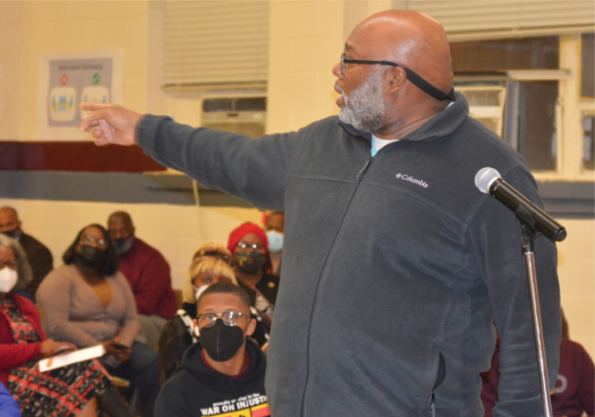 Steve Smith, an Inverness Elementary alum, offered some counterpoint arguments during Tuesday’s school board meeting.
“I’m just as hurt as anybody else, but what we’re facing now, it’s a reality of life y’all. It’s a reality of life,” Smith said.
Smith admitted during his comments that he had once removed his own children and sent them to private schools, but he noted the vast improvements that have been made in the district since that time.
“I watched closely this school district, and I’ve been critical of this school district, everybody knows I have. I see drastic improvements in this school district,” Smith said.
Smith then said that decisions made by the town of Inverness itself were at the root of the school’s attendance issues.
“When they wanted to build more apartments, the town didn’t let them do it. When they wanted to build more houses, the town didn’t let them do it,” he said. “You killed your own population, and now you’re crying wolf. The hens have come home to roost.”
Smith then asked the board to look into all possible ways to save the two schools.
“If there’s a way possible. I see everybody came up and identified the problem. If there’s a way possible, try to. That’s all I can ask,” he said.