There was always something special happening at Gentry High School when Coolidge Ball hit the court.
The talent displayed there took him to the SEC where he broke the color barrier for Ole Miss athletics and was awarded All Conference and eventually a bronze statue outside the Ole Miss Pavilion, where the team now plays. Ball passed away on Tuesday at his home in Oxford at the age of 71.
Dr. Cassie Pennington had known Coolidge since his junior high days as a ninth grader. Dr. Pennington taught at Gentry and also was a local basketball referee. He got to see the basketball talent up close.
“I had just started refereeing and he’d just started playing,” Dr. Pennington said. “You could tell that he had it all. He had all the tools and you could tell he was going places. He had the discipline. Always had a good attitude and always played hard. He was talented.”
Ball’s Gentry career included 1,800 points, All-Delta Athletic Conference nods from 1968-70 and All-Southern and All-State honors in 1970. He averaged 20 rebounds in high school and “he could jump. He could sky,” Dr. Pennington said.
He noted that Gentry did well in those days winning conference championships but didn’t bring home any state championships. Ball followed the late Sam Lacey, who after graduating from Gentry went on to nationally ranked #3 New Mexico State University and eventually a successful NBA career. Ball was actually recruited by New Mexico State (and several others) and signed scholarship papers but not the national letter of intent. But after a month or so out west, Ball had a change of heart.
“He told me that once he got out there he just didn’t like the atmosphere at all. They had guys from New York and he just didn’t fit in with that. He couldn’t go along with what they were doing out there,” Dr. Pennington said.
The man affectionately nicknamed “Coolaid” put in a call to Ole Miss who had heavily recruited him and Oxford welcomed him with open arms. The Indianola basketball prodigy earlier had been cheered at Tad Smith Coliseum by Ole Miss fans when recruits were introduced at halftime festivities. Dr. Pennington remembers vividly Coolidge’s talents on the SEC hardwood. And Coolidge competed in the era when the SEC was breaking the color line across the board.
“Alabama started five African Americans and Kentucky had a seven-footer. The SEC was just starting to integrate,” he said. “It was exciting.”
Ole Miss alum and Indianola resident Richard Noble noted, “He liked Ole Miss and Ole Miss liked him. He was one hell of a basketball player. He didn’t consider himself being the first Black athlete. He said he played because he wanted to. He supported the Ole Miss athletic department and he would visit the team all of the time. He was a part of Ole Miss and stayed a part of Ole Miss. He was a class act.”
Ole Miss was never far from Coolaid’s heart as Noble explained, “Every time I saw him, he had an Ole Miss shirt on. An Ole Miss golf shirt – he was an Ole Miss Rebel.”
Noble noted that Coolidge was “smooth and hard to guard. He was one of a kind and was a star in the SEC and a star for Ole Miss. It didn’t make any difference if he was Black, green, yellow or white – he was an Ole Miss Rebel through and through.”
In an online article, Ball said he knew he was blazing a trail, stepping into uncharted waters, at a place where no one of his race had participated in sports, and most before him never had the opportunity to do so. He knew the story of James Meredith, the path he had traveled, and the door that had been opened by him.
“This was only eight years removed from James Meredith enrolling to me enrolling,” Ball said. “My decision was pretty much based on the ovation, the applause and the support I got out there that night when Ole Miss played Kentucky on my recruiting visit. If you have your coaches, teammates, and fans supporting you, I wasn’t worried about anything else.”
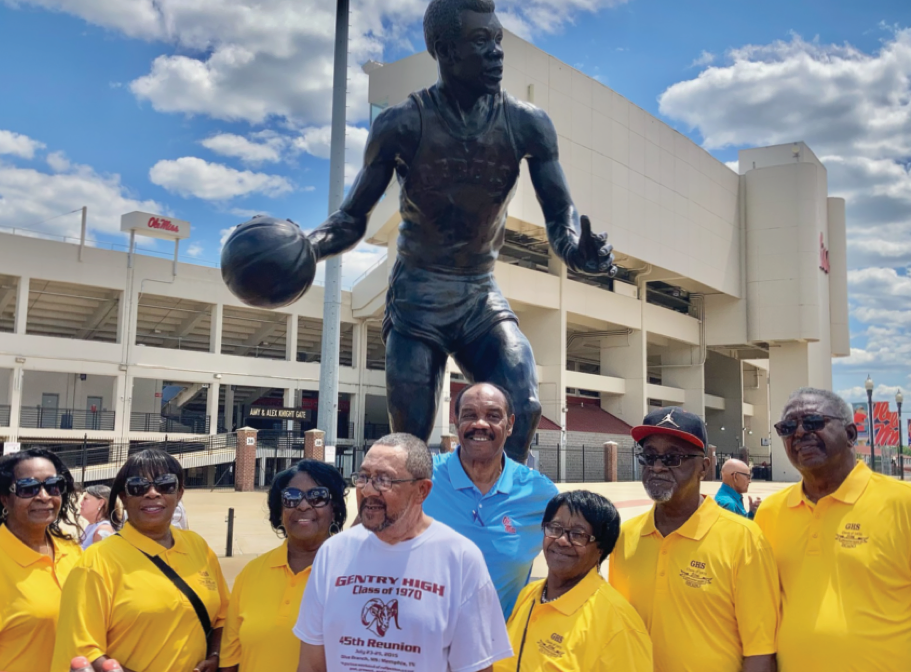 Several members of the Gentry High Class of 1970 attended the unveiling of the statue of Coolidge Ball at Ole Miss. Pictured left to right: Anita Hayes, Lindell King, Mary McGee, Perry Price, Coolidge Ball, Willie Mae Steen, Henry Baker and Steve Hayes.
Ball quickly admits his time at Ole Miss was good and that there were no problems with anything concerning his race.
“I got treated just like any other 18-year old freshman on campus,” he said. “It was just a great fit for me.”
The Rebels had three consecutive winning seasons for the first time in more than three decades. He was also named team captain and earned team MVP honors. Following a selection to the 1971 All-Southeastern Conference Freshman Team, he played his first varsity season the following year. As a sophomore, Ball led the team by averaging a double-double at 16.8 points and 10.3 rebounds per game and was named to the All-SEC Second Team in 1972. He followed up with all-conference honors the following year and was a three-time United Press International honoree in each of his three varsity seasons.
He scored 1,072 points and 752 career rebounds during his three varsity years at Ole Miss and guided the Rebels to three consecutive winning seasons. Earning team captain and MVP honors, Ball was one of the most respected players in the men's basketball program and on campus.
Ball earned numerous accolades following his playing career at Ole Miss. He was inducted into the Ole Miss Athletics Hall of Fame in 1991, the Mississippi Sports Hall of Fame in 2008, and was named an SEC Basketball Legend in the class of 2005. He earned a spot on the Ole Miss Men's Basketball All-Century Team in 2009, and in 2021, was honored with a bronze statue that stands in the Pavilion Plaza.
“He was one fine young man. He was a pleasure to be around and he called me every week,” Dr. Pennington said. “He loved Ole Miss. His passion was Ole Miss. He followed all Ole Miss sports and he loved SEC sports. He’d always call me after games and we’d talk. SEC sports was his life. We’re going to miss him, I tell you.”
Ball made his home in Oxford with his wife, Ruth and their children, Anthony and Telitha.
After a short assistant coaching stint at Northwest Community College, Ball came back to Oxford and actually was an assistant coach for one season under Bob Weltlich according to Dr. Pennington. But the art major opened his own business in 1979, Ball Sign Company in Oxford, as a sign painter and a graphics expert. Ball spent time traveling to arts and crafts shows as well as horse shows and other events to sell his products.
Visitation is set for Friday at 3 p.m. at the Tallahatchie-Oxford Missionary Baptist Association Building. The funeral service will also take place at the facility on Saturday at noon.
A true Ole Miss Rebel and Sunflower County legend, Coolidge “Coolaid” Ball.