Dr. Wade Dowell was on his way to his deer camp back in December when he got the call that the first COVID-19 vaccines had arrived at Indianola Family Medical Clinic.
Instead of enjoying the weekend away and taking his shot the following Monday, he turned around and drove all the way back to the clinic to be one of the first in the county to take the shot.
“I was actually going to deer camp, and I turned around and drove back once I knew we were going to get them that day,” Dowell said. “I canceled plans to come on and get it, because I wanted to get it as soon as I could.”
Dowell, along with other health care professionals at the clinic and South Sunflower County Hospital, took their first shots during the middle of the winter surge, when demand for vaccines was still relatively high and supplies were limited to certain segments of the population.
After a sharp drop in COVID cases, hospitalizations and deaths this spring, it appears that another wave is moving across the state, perhaps bolstered by the new Delta variant of the virus.
Vaccines are readily available, but demand has waned, with the state sitting between 30-35% fully vaccinated.
Sunflower County is 36% fully vaccinated, and at least 40% have received at least one dose.
“We’ve seen these young folks who died unnecessarily in the last year, so many deaths, that had we had a vaccine a year ago, people would have been beating our door down. If we told them we didn’t have it, they’d be rioting and beating our door down wanting it,” said Dr. Eddie Donahoe, who had COVID last year and was the first to receive the vaccine at the clinic back in December. “And then all of the sudden, we get enough available, and people say, ‘It’s not that big of a deal. It’s about gone, and I’m not going to take it.’ What they’re doing is relying on the herd to be immune, and the herd’s not immune.
The local doctors say there’s a lot of pushback based on information being spread on social media.
“Multiple people have told me they felt like it was a government conspiracy, they were putting some kind of microchip in you,” Dowell said. “What’s so ridiculous about that, every one of these people has a cellphone. The government knows everywhere you go and everything you say anyway…I’ve had a lot of that.”
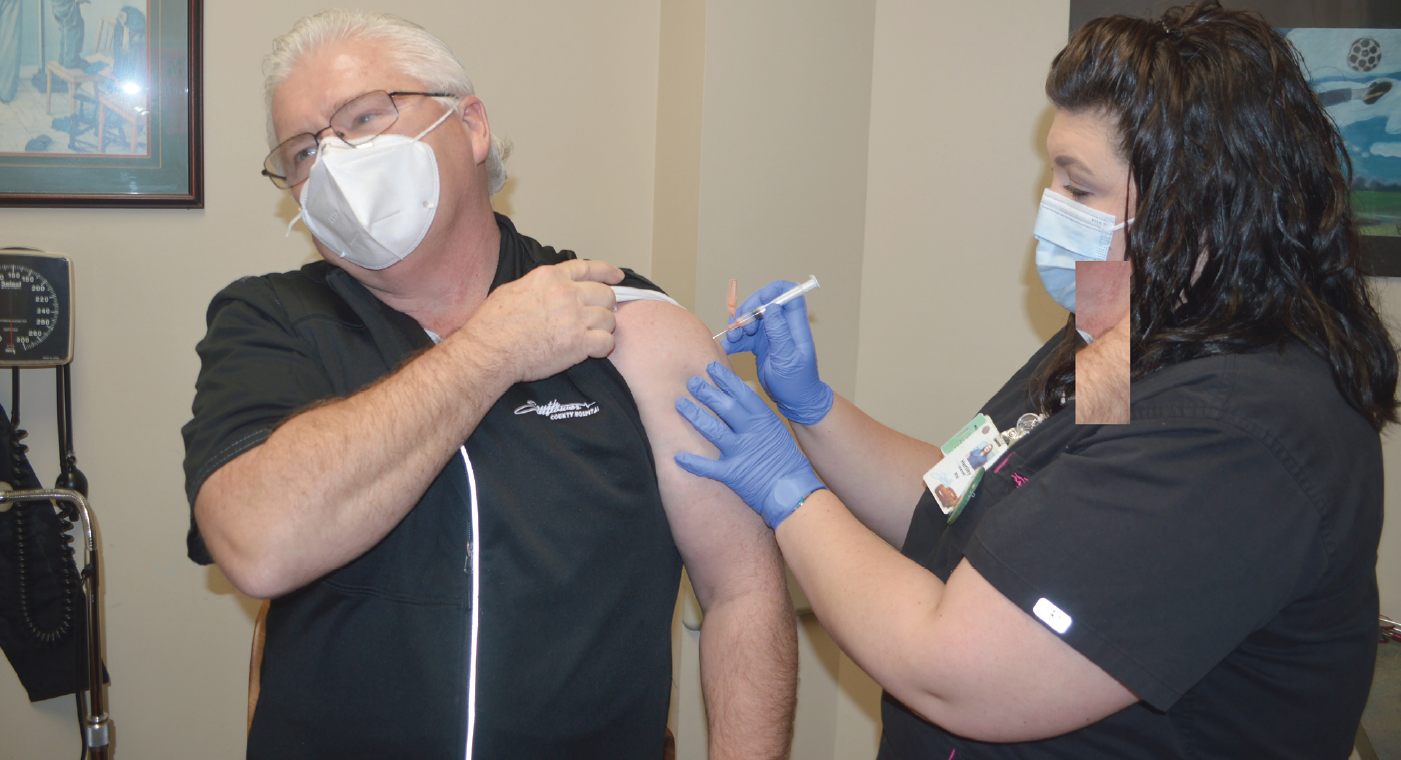 Dr. Eddie Donahoe receives his first dose of the COVID-19 vaccine from nurse Henley Harrell back in December.
Doctors are also hearing from patients who question the safety of these particular vaccines, which were approved for use by the Food & Drug Administration under emergency circumstances.
But Dowell said the science behind the vaccines in use is sound, and the research used in developing them in such a short period of time is not as new as some might think.
“A lot of the research that went into this vaccine had been done in years past when the first SARS epidemic came eight or nine years ago,” Dowell said, adding that the developers simply had to change some of the gene sequences in the development to create the COVID-19 vaccines. “A lot of the groundwork for this had already been laid, so we really didn’t start from scratch with this vaccine.”
Donahoe said he believes a lot of the misinformation about vaccines is spread on social media platforms.
“We’re seeing more and more resistance, and I think most of it is based on social media and what people are seeing on social media, and people believe whatever they want to believe,” he said. “Bottom line now is if you get COVID now, it’s nobody’s fault but yours.”
Dowell said there have been a few “breakthrough” cases when it comes to the vaccines, meaning some who have gotten vaccinated have contracted the virus, but he said most of those cases have been mild, with few hospital admissions.
He also noted that doctors believe those who had COVID-19 last year may not have immunity against the Delta strain and other variants, but those who have been vaccinated seem to have immunity against the variants.
For Donahoe, relying on immunity from his prior infection is not a risk he was willing to take.
Donahoe said that he had a fairly mild case of pneumonia when he had COVID, but the long-term effects of the virus still linger.
“Now, I just don’t have the long-term endurance,” Donahoe said. “That’s a long-term effect…You just feel like you never can breathe well, and there’s just so many other things with COVID you just don’t want.”
Dr. Hannah Ray and Dr. Katie Patterson spent a considerable amount of time working with COVID patients and helping to run the COVID unit at SSCH during the height of the pandemic.
The low vaccination rate and new variants like the Delta strain have them worried reopening the hospital’s COVID unit may be a reality soon.
“There has also been a higher number of hospitalizations seen with this variant, particularly among younger, healthier individuals; this is very concerning for our state as many of our younger aged citizens have not been vaccinated yet,” Ray and Patterson told The Enterprise-Tocsin. “It also renews the concern that our hospitals may quickly reach their capacity again, and the strain on our medical system could get as bad or worse than with the first wave.”
Until this past winter, there were just a few measures available for fighting the spread of COVID, which included masks and social distancing.
With multiple vaccines available to ages 12 and up, Dowell and Donahoe say the next wave of cases, hospitalizations and deaths will have been preventable.
“It’s a no-brainer,” Dowell said.
“Scientifically, it makes no sense to see people suffer from something that’s preventable,” Donahoe added.
Ray and Patterson say Indianola’s doctors are available to anyone who might have questions or concerns about the vaccine.
“Please, make an appointment to get vaccinated,” they said. “You don’t need insurance, and you don’t have to pay; you just need to call! If you have questions or concerns about the vaccine, come see us at the clinic; we would be happy to answer your questions and address your concerns. At the very least unvaccinated people must practice good social distancing and continue to wear masks, to protect themselves and their loved ones.”
For Dowell, his message to patients is short and simple.
“You’ve got a choice,” he said. “You’re either going to get the vaccine or you’re going to get COVID, one or the other, but it’s going to happen, because it’s not going anywhere.”