The issue of increasing the pay of teachers and recruiting more to fill shortages was addressed Wednesday in a more than three-hour hearing by the Senate Education Committee.
Lawmakers heard from officials from the Mississippi Department of Education, the state economist, the state insurance administrator the state’s defined benefit pension (the Public Employees’ Retirement System of Mississippi) and the Southern Regional Education Board.
Just evaluating Mississippi teacher pay in a vacuum would lead one to the conclusion that another pay hike is in order. According to data, the starting salary for teachers in Mississippi (absent any additional pay from their district) is $37,000, which is $3,300 below the Southeastern Region average.
Average salary for teachers in Mississippi is approximately $8,200 below the Southeast average. According to the MDE, salary supplements from districts can range from $1,400 to $7,400 on top of their base salary provided by Mississippi Adequate Education Program (the funding formula that determines how much each district receives in state education funds that make up most of most district budgets). Five or six districts according to MDE provide no salary supplements for teachers.
Lawmakers have been busy since 2000 trying to redress this issue via legislation.
A raise passed by the Legislature this year would be the fifth pay hike for teachers since 2000. In 2000, a $337 million plan was enacted over a six-year span. In 2014, a two-year, $100 million plan passed by the legislature increased teacher pay $1,500 in the first year and $1,000 in second.
Last year, a $1,100 pay increase bill was signed into law by Gov. Tate Reeves.
Mississippi has one advantage over its neighbors and that is the lowest cost of living nationally as measured by the Regional Price Parity index authored by the U.S. Bureau of Economic Analysis.
The top state, Hawaii, had a cost of living in 2019 that was 19.3 percent more than the U.S. average. The Magnolia State was 15.6 percent lower than the national average that same year.
According to state economist Corey Miller, Mississippi has been the lowest or tied for the lowest in the RPP rankings all but once since 2008, when the BEA begin tabulating the rankings. Seventeen states in this measure have ratings above 100, which means that their cost of living in 2019 was higher than the U.S. average.
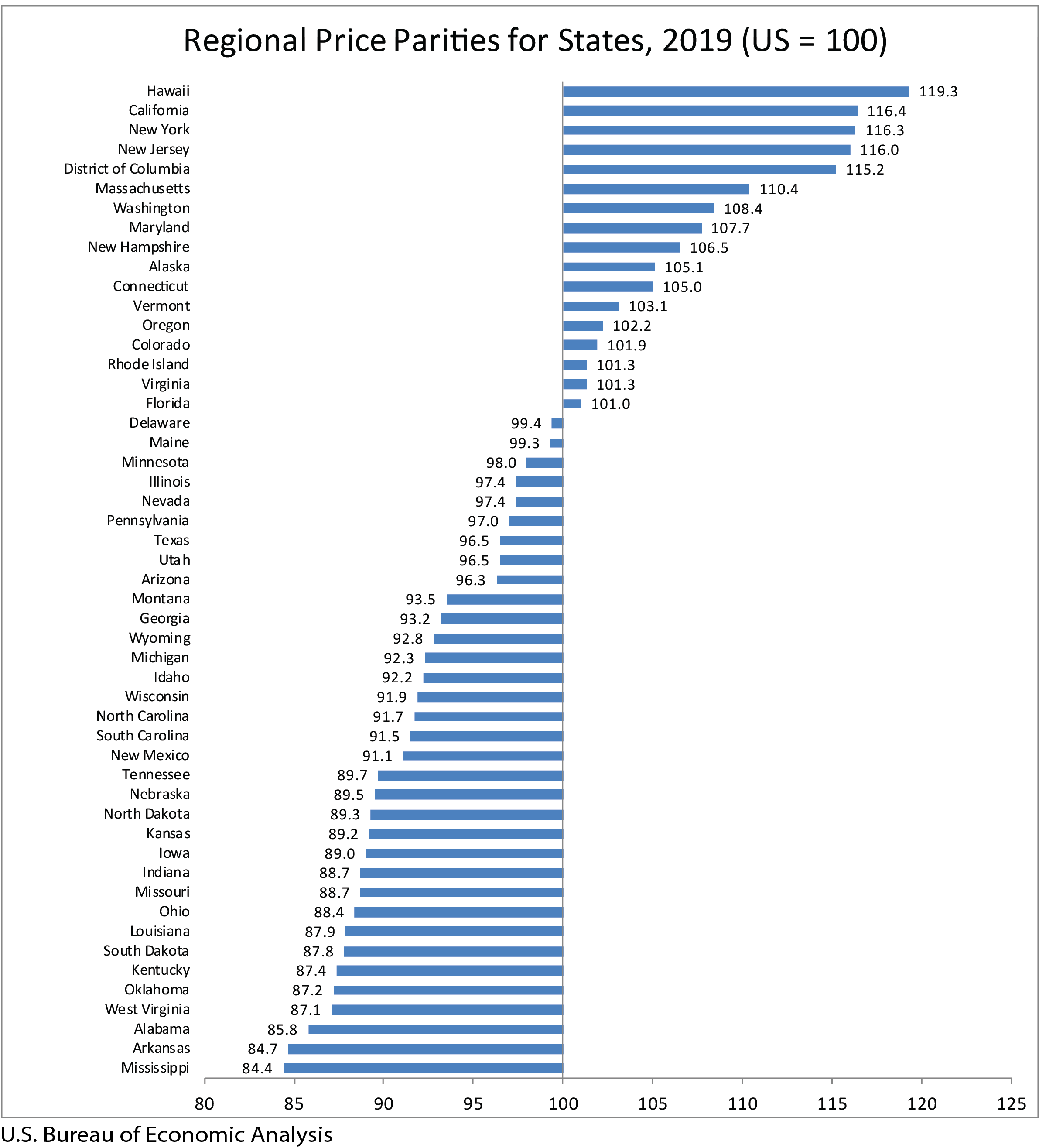
Adjusting the RPP with the average salary shows that while Mississippi teachers earn less ($46,800 on average according to data from the National Education Association) than their counterparts in other states, they earned more ($55,500) than three other states that had much higher RPPs than Mississippi (Arizona, Hawaii and Florida).
Except for Georgia (ranked 19th in average teacher salary), all the states that border with Mississippi were ranked between 35th and 47th.
The bordering states also improved under this analysis.
The Southern Regional Education Board’s Megan Boren told lawmakers they want salaries for teachers increased, merit raises based on accomplishments and demonstrated competencies, stipends for continuing education, lower health insurance costs and a shorter vesting time for their pension benefits.
One issue with teacher retention as raised by state Sen. Briggs Hopson, R-Vicksburg, is the seeming overwhelming omnipresence of the state-mandated assessments that are used to rate districts and individual schools. Studies have shown that over-emphasis on “teaching the test” is leading to burnout among teachers, many of whom don’t make it past their first five years in the profession.
“Obviously we want quality assessments and I do believe that a state assessment is important to evaluate the fairness and equity of instruction across multiple districts,” said SREB President Stephen Pruitt. “However, when we make that such an important part of an accountability system that overrides all of the other important aspects, the research supports that if we teach students how to apply, even if they take a lower quality test mounted in memorization, that they still perform excellent on that because they were able to apply that information.”
Jackson metro area teacher supplements
- The Jackson Public School District’s salary schedule shows supplements ranging from $2,221 for a new teacher to $6,308 for a certified teacher with 26 years of experience or more and a doctorate.
- The Madison County School District has supplements for teachers ranging from $2,500 to $3,500, dependent on experience, certification and education.
- The Canton Public School District’s local supplement ranges from $3,700 to $4,000.
- The Hinds County School District pays supplements between $2,125 to $5,965.
- The Pearl School District has supplements ranging from $2,650 to $3,450.







