HUD’s Community Development Block Grant program also funds buyouts after disasters.
Its one-time National Disaster Resilience Program funded the Isle de Jean Charles community relocation effort in coastal Louisiana in 2014. The island, which once encompassed 22,000 acres and now has only 320 acres, is disappearing into the Gulf of Mexico from soil erosion and the rising sea level.
In 2016, Louisiana was awarded $48.3 million in Community Development Block Grant funds to work with residents of Isle de Jean Charles to develop a voluntary plan to relocate to safer communities including developing the New Isle, a planned community about 40 miles north. Six years later, the New Isle project is ongoing.
The Building Resilient Infrastructure and Communities grant program makes federal funds available to states, U.S. territories, federally recognized tribal governments and local governments for hazard mitigation activities, recognizing the growing hazards associated with climate change.
Also, the Biden’s administration $1 trillion Bipartisan Infrastructure Law, signed into law last November, earmarks $3.5 billion in flood mitigation grants over five years. As part of that funding, the administration recently announced $60 million in Swift Current funding to four states, including Mississippi. Louisiana received the bulk of the money -- $40 million. New Jersey received $10 million; Pennsylvania, $5 million; and Mississippi, $5 million (for a bridge project in Biloxi).
The new Swift Current initiative will expedite mitigation grants to disaster survivors with repetitively flooded homes. This is the first FEMA initiative funded through the Bipartisan Infrastructure Law to strengthen national preparedness and resilience.
The four states were selected because they have the highest number of unmitigated severe repetitive loss and repetitive loss properties insured under the National Flood Insurance Program and total flood insurance claims within their respective FEMA regions.
The Brooklyn, New York-based First Street Foundation, a nonprofit research and technology group working to define the nation’s climate risk, said the flood risk in Mississippi is increasing. The state currently has 255,700 properties with substantial risk of flooding, but over the next 30 years, that risk will increase by 9.8% to 280,700, according to the First Street Foundation. The Biden administration used Its information for the Swift Current initiative.
The First Street Foundation Flood Model found 10.3% of all properties across the contiguous United States at substantial risk of flooding today, and 11.4% at substantial risk in 30 years. Mississippi has a greater proportion of properties as substantial risk, with 13.6% at substantial risk today and 14.9% at substantial risk in the year 2050, the foundation says.
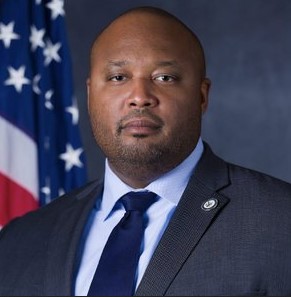 Delta Regional Authority Co-Chairman Corey Wiggins is urgeing FEMA officials to come up with a solution to flooding that is equitable for all. Official photo
Charles Taylor, executive director of the NAACP, urged FEMA officials to come up with a solution to flooding that is equitable for all.
“It’s important that we have solutions with equity,” Taylor said at the Aug. 24 meeting. “If we don’t fix this, the suffering will continue.”
A previous version of this story misattributed a comment made at the Aug. 24 town hall. Charles Taylor, executive director of the NAACP, urged FEMA officials to come up with a solution to flooding that is equitable for all. “It’s important that we have solutions with equity,” Taylor said. “If we don’t fix this, the suffering will continue.” The comment and quote were misattributed to Delta Regional Authority Co-Chairman Corey Wiggins, the former NAACP executive director.
-- Article credit to Jimmie E. Gates of the Mississippi Center for Investigative Reporting --







