Author’s Note:
The powerful photographs that accompany this account were taken by Allen Cooper, a civil rights veteran from Albuquerque, New Mexico, who was in Indianola, Mississippi, in 1965. He generously shared the images with me in 2000 and described how, at the time, he had to conceal that he was taking them. Many of those mentioned in this essay are no longer with us, but their courage and commitment live on. I dedicate this essay to the memory of all who endured the firebombings of 1965—and in gratitude for the strength they showed us.
In the May 2, 1965, edition of The Delta Democrat-Times, white civil rights veteran Allen Cooper of Albuquerque, New Mexico, described how COFO volunteers John Robinson, a 32-year-old white activist from Los Angeles, and James Harris, a local Black resident, were asleep at the Freedom House when Molotov cocktails were hurled through a rear window. Fortunately, both men were able to push their burning bedrolls aside and escape unharmed. Allen noted that another Black resident, Maurice Cooper, managed to extinguish part of the fire. Around the same time, the Magruder house, located a block away, was also targeted with multiple Molotov cocktails. Though unsure of the exact number, Allen estimated that four or five were used, and the house was engulfed in flames within minutes. Despite the devastation, Irene Magruder and the five others inside escaped unharmed, as did the Giles family.
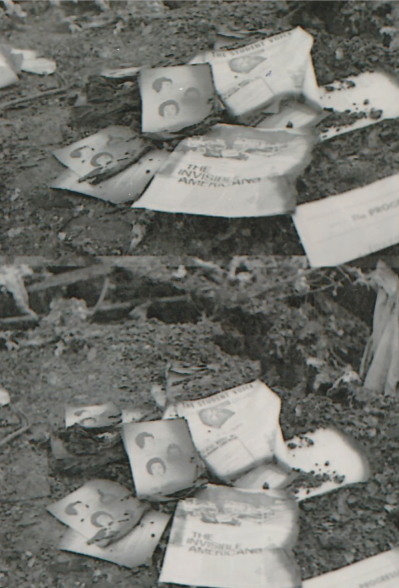 Singed remains of The Student Voice, SNCC's newsletter, in the front yard. Photo by Allen Cooper
In another article from the same paper, titled “Indianola COFO Worker Claims He Knew Bombing Was Coming,” Fred Winn, a white COFO volunteer from California, recalled being asleep in the Magruder home. Awakened by loud voices, he grabbed a soda-acid extinguisher and tried to contain the flames in the front bedroom, but the heat and smoke drove him out. “All I could grab was the cash box, account book, and my Bible,” he said.
Multiple agencies—including the Federal Bureau of Investigation (FBI), state highway patrol, state fire marshal’s office, and the Sunflower County sheriff—launched investigations.
No one was ever charged for the firebombings.
My father, Dorsey M. White, Jr., vividly remembered that night. In the dead of night, my parents received a phone call: Irene Magruder’s house had been set on fire. My mother, Bernice Magruder White, and my father quickly dressed and drove their 1961 yellow Chevrolet Impala to Byas Street, leaving my older sister, Brenda, to watch over my twin sister, Marsha, and me. Marsha and I were just months away from our sixth birthday.
When they arrived, they saw that the firemen had deliberately placed their hoses behind their vehicle—possibly hoping my father would run over them and be arrested. About a hundred neighbors stood watching as the firemen idly stood by, making no effort to put out the flames. My parents found my great-aunt shaken but not surprised. Word was spreading through the crowd that our house on the corner of Roosevelt and Gray Street would be next. My parents rushed home.
For the next several months, my parents took turns guarding the house with a .38-caliber pistol. My mother, Bernice Magruder White, kept watch from 6 p.m. until 11 p.m. Then, my father took over and stood guard until morning. Each night, they rigged a makeshift alarm system: empty tin cans tied together with a thin rope and strung along the hedges that lined the backyard. If anyone disturbed it, the rattling noise would alert them. The alarm was positioned about three feet off the ground—just low enough for a dog to walk under without setting it off. My parents went into full protection mode, constantly watching for anyone who came close to the house. My mother spread the word throughout the neighborhood, asking people to walk on the east side of Gray Street—away from the house—instead of the west side. The neighbors obliged.
My father left the car at the scene for the rest of the night and walked back to retrieve it the next morning. When my parents returned, Brenda, Marsha, and I walked with them. Neighbors still stood outside, observing the remains of the burned-down home.
Though the flames had died down, Allen Cooper quietly photographed the ruins of Irene Magruder’s house. Using a camera concealed in a cardboard box with a small hole, he managed to keep it from being confiscated.
We were relieved to learn that my great-aunt Irene was safe and unharmed, but we soon discovered her homeowner’s insurance had been canceled months earlier—a tactic often used to intimidate Black residents. After the firebombing, Hodding Carter gave my great-aunt his business card and told her to call him if she needed anything.
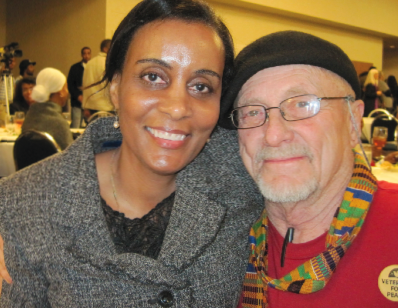 Stacy J. White with the late Civil Rights veteran Allen Cooper in 2010. Photo Courtesy of Stacy J. White
Anticipating trouble, my cousin Annie Lee had quietly taken her to an insurance company in Greenville and secured a new policy. The arsonists had no idea she was still covered. Irene moved in with us until a new brick home was built at the site of her old residence.
The intimidation extended beyond Irene Magruder. The Giles family’s insurance had also been revoked. Alice Giles feared something would happen—and it did, on her birthday. Though Oscar Giles hesitated to call the fire department, Alice Giles called anyway. Neighbors helped them fight the fire. Fortunately, no one was hurt.
But there was resilience.
Devastated but undeterred, the Kings, Magruders, Gileses, and Wilders refused to be driven out. They rebuilt their homes and their lives, determined not to let fear dictate their futures. The firebombings of May 1, 1965, were meant to crush the movement’s momentum. But the courage shown by Irene Magruder; Oscar and Alice Giles; Estell King; and Dudley and Annie Wilder—along with the civil rights workers and neighbors who stood with them—laid the foundation for generations of progress in Indianola and Sunflower County.
Sixty years later, their stories endure—not as tragic footnotes, but as enduring lessons in resistance, dignity, and hope.