Over a century of hard work and more work to come.
Celebrating 113 years on its Founder’s Day, The Sunflower County NAACP Branch #5333 held its annual Black History Program at the B.B King Museum this past Saturday.
This year’s program’s theme was “There is power at the ballot box to change communities.”
NAACP President Charles Modley talked about the power of the ballot and the need for people in office to vote on things that affect the community such as education and curriculum.
“In the future, we may not be able to celebrate Black History Month,” Modley said. “Because that is critical race theory that they don’t want to hear.”
Keynote speaker Judge Carol White-Richard touched on the theme by posing a question to the audience.
“We have the ballot, but my question for you is, what are we doing with it?” White-Richard questioned.
White-Richard recounted the hardships that African Americans faced in efforts to gain voting rights and the measures they took to gain the power of the ballot.
When White-Richard ran for office, she questioned the power of the ballot as well.
“When I ran for judge, my concern was not gerrymandering, it was not voter ID or voter fraud,” White-Richard said. “My concern was rain. Was it going to rain? I knew if it rained the voter turnout would be very low.”
White-Richard shared recent statistics of the poll that revealed a low voter turnout.
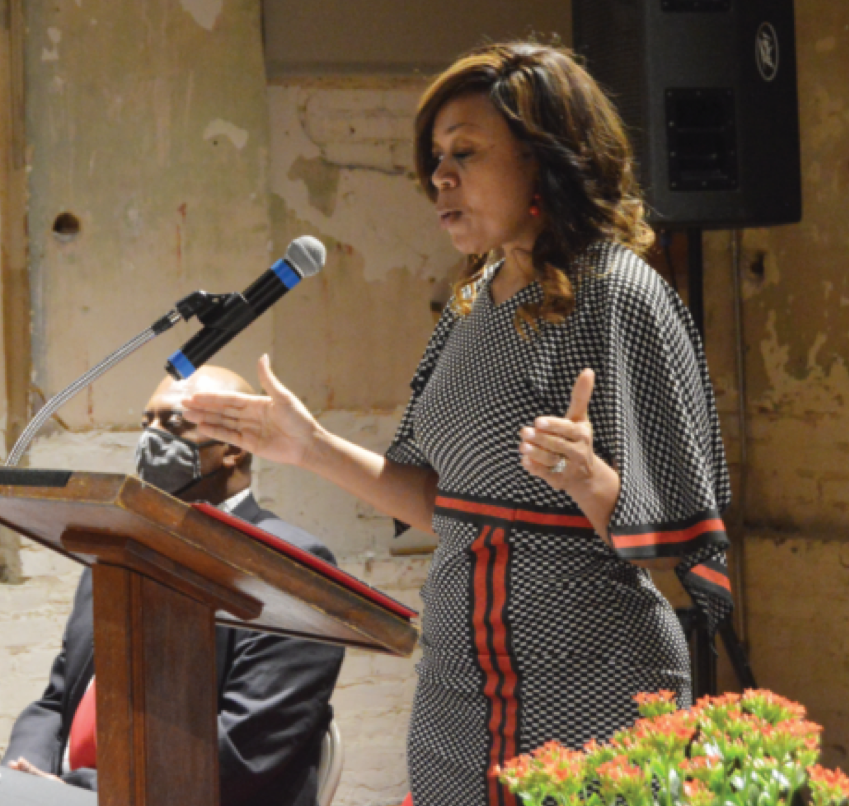 Judge Carol White-Richard was the keynote speaker for the 2022 NAACP Black History Program at the B.B. King Museum last Saturday.
“If you think one vote doesn’t count or it’s too small to make a difference, try sleeping in a room late at night with a mosquito,” she said.
White-Richard told the audience that the ballot was their tool for survival.
“We are used to being survivors, White-Richard said. “We are used to taking 75 cents and making it into a dollar. We need that survivor spirit in 2022. We need that survivor energy when it comes to understanding the ballot and getting out to vote”
White-Richard concluded with an anecdote about two men fishing on a riverbank.
One man saw multiple babies drifting down the stream. One man went to save the babies and the other man went upstream to see who was putting the babies in the water.
“We need some people going upstream, because the only way to get our babies out of the water, the only way to go upstream is by understanding the power of the ballot.”
A dramatization of Fannie Lou Hamer brought the presence of a civil rights activist who is nationally known for her work for encouraging African Americans to vote.
Mrs. Helen Sims performed a dramatization.
Gentry High School’s Drama Club also performed dramatizations for Martin Luther King Jr, Malcolm X, Emmett Till, and others.